In a photo from my childhood, me and my brother are marveling over a tiny frog in the palm of our father’s hand. Our dad’s face is softened in an uncharacteristically relaxed smile. It’s a snapshot of close family proximity made possible by a sprinkling of magic and wonder.
I have no idea where the frog came from. Our home was situated in what I always thought must be the hottest neighborhood in the San Fernando Valley – Reseda. The closest source of water was the 51-mile concrete-lined Los Angeles River that, in the late 70’s, wasn’t exactly a wellspring of healthy habitat. Even after heavy acid rains, a natural puddle was hard to come by.
But we had found her somewhere, and we were all enamored with this most fragile creature. None of us knew anything about amphibians, and I’m sure we didn’t even know the word existed, but we loved her anyway.
I forgot about frogs for another 45 years until I began volunteering for our zoo’s Amphibian Monitoring Project. At the time, I was writing a nature-themed novel, and set out to immerse myself in biodiverse pockets of nature wherever I could. Dipping wader-deep in a protected wetland searching for goopy egg masses seemed a sublime way to gain an experience I could then put into words for that one sensory scene. Of course, I got much more out of the experience than sights, sounds, and scents.
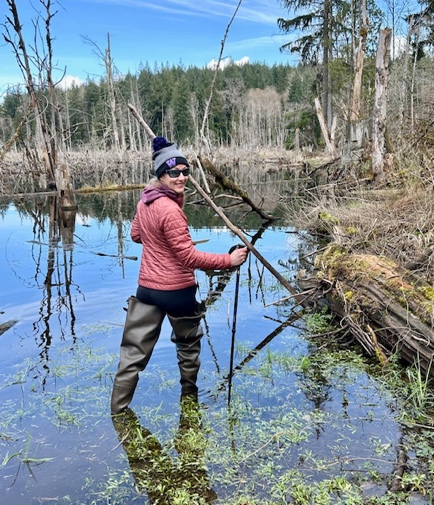
Amphibians around the world are the class of species most at risk of extinction, with 40% threatened. They are particularly sensitive to pollution and pesticides due to their porous skin, and their wetland habitats have been filled and packed with development for a century. Our zoo’s Amphibian Monitoring project trains field volunteers to collect data in iNaturalist to determine where amphibians live in our area to inform future conservation projects. I was so grateful for this opportunity as a non-scientist to contribute while learning.
Our monthly job was to first document egg masses of the four species most likely to exist here – Pacific Tree Frog, Northwestern Salamander, Northern Red-legged Frog, and Long-toed Salamander. And then to return every month and track the progress of the eggs from newly hatched crescent moons to zippy tadpoles to evasive juveniles to amorous adults (I did witness a few happy frogs in amplexus).
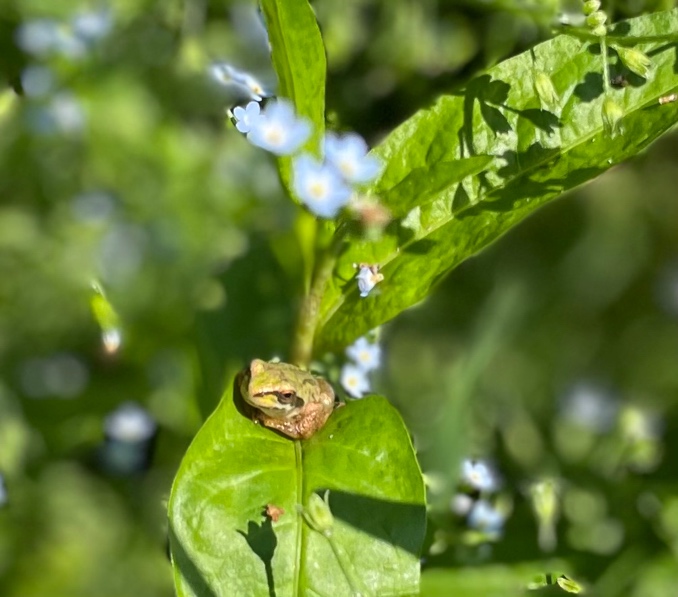
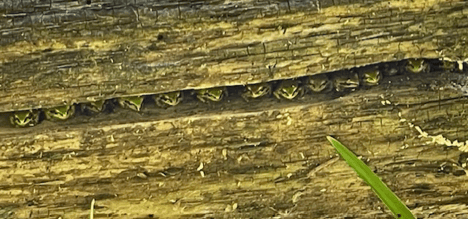
It was at some point near the end of my first survey season, spotting Pacific Tree Frogs hanging on blades of grass, sunning on leaves, and dodging my camera, that I realized:
Oh. Yes. I do in fact love amphibians.
The idea of amphibians had been hidden on the periphery of my consciousness all my life. They weren’t fuzzy or furry or warm, and most people didn’t delight in them as they did with dogs or cats. But as it happens, the more you learn about something, especially something in danger, the more you grow to care, and then to love. And really, there are some adorable frogs and salamanders out there to save.
Amphibians deserve to be allowed to survive in their own right, as do all other creatures who made it this far on our planet, but they’re not just beautiful and adorable. They’re also essential to our global ecosystems and food webs, and are indicator species letting us know when we’ve really screwed up our environment.
Out in the field we always hoped to find lots of egg masses and amphibians progressing in their life cycles because we knew it meant this particular pond or marsh was healthy and unpolluted. It’s an immensely good feeling to look upon a thriving ecosystem. Our biophilia kicks in, releasing serotonin and a sense that all is well in the world.
And there are so many incredible creatures out there to discover, learn about, care about, and love. We only have to look, and allow ourselves to smile.