Every year, tending to the ritual of springtime weeding, I lay compost in select areas of my yard. Probably less than is required for optimal soil health, but I figure the benefits compound over the years, so I do just enough to feel like I’ve nurtured my plant family.
This used to be manageable for me, but as the years progressed, my back has taken notice. Last year before hauling about bags of mulch, I had to warm up as if I was about to attempt a deadlift personal record. Back brace hidden under a puffy jacket, I bent and squatted and contorted such that it was obvious to anyone walking by that I was musculoskeletally impaired.
So this year I thought, what the heck, I’ll hire someone to deliver and lay the mulch. The relief in this decision was exhilarating. My back instantly relaxed. I asked the landscaper to get that beautiful, dark compost from the well-reputed brand I’d been using for years. (Note that I use mulch and compost interchangeably, silly me.)
When the job was completed around sunset, I gazed out at the deep and tidy layer tucking in my perennials for a cozy night’s sleep. My yard looked amazing. So healthy, so nourishing, the compost containing all the elements necessary for thriving botanical life. My plants would show their gratitude in a springtime splendor of lushness and color. The bees would follow in summer and all would be well on my little stamp of land. Oh happy day.
The next day proved perfect timing for the laying of compost. A daylong downpour patted it down and began the work of percolating nutrients into the soil. Tea mug in hand, I watched those drops hit the compost with impact and purpose.
The day after that, I took my dog Chloe for a long walk to make up for the previous day indoors. The neighborhood shimmered crisp and clean, the birds chirped their elation, and my yard glowed proud in the middle of our street. Chloe had waited to poop in our own yard (good girl), and as she is only 6 pounds, locating her scattered candy-sized deliveries requires attention and visual acuity. That’s when I saw them. Next to her peanut M&Ms, dozens of bits of plastic.
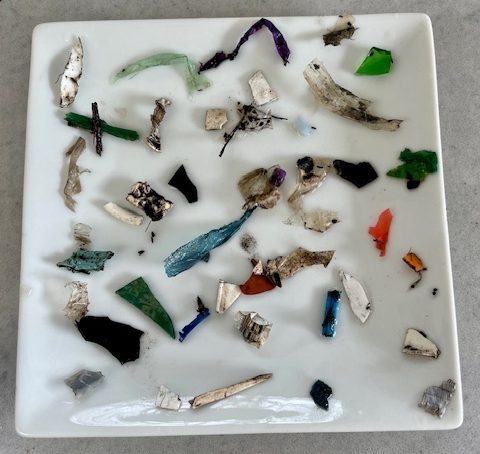
Disbelief at first. Impossible. I scanned the ground around me, walked the perimeter of my yard. Blue, green, white, a few orange and red. Hundreds of bits. Thousands. The rain had scrubbed away the dirt to reveal that the compost was chock full of plastic. I stood in shock. I felt them in my belly.
This photo is from two feet of rinsed compost.
Now, this would annoy some people more than others. I am of the former. I’d been digging in to the harms of plastic for years, from the extraction of oil, to the production of petrochemicals, to the manufacturing of products, to the myth of recycling, all toxic and polluting. This book is an efficient read that will have you happily relinquishing plastic wherever possible.
I carry my own cup and utensils in my purse so that I don’t have to throw away single-use. I bring mesh cotton bags for produce at the store, and canvas bags for the groceries. I bring containers to restaurants for leftovers, and avoid take-out unless I can use my own containers. I practice superhuman resistance when passing the mountain of beautiful, healthy, packed-with-antioxidant berries in clam-shells. Though the clam-shell often wins.
We didn’t create the problems with plastics. The oil, petrochemical, and plastics industries will stop at nothing to make sure we don’t have much choice in the matter. As gasoline slowly goes out of style, they will keep using the oil to make plastic.
And now despite all my efforts at avoiding plastic, my front and back yards were covered in it. What if a bird tried to eat one of the shards and cut their tummy? What if the lighter bits flew away all over the neighborhood? How long before they’d wash into the storm drain and out to Puget Sound where marine life is already dealing with enough pollution?
Breathing through my dismay, I accepted that this would be a Project. It would gnaw at me for some time, slowly breaking down into micro-stressors but never entirely decomposing.
I had to frame the issue such that I wouldn’t startle in the night short of breath from dreaming of a fledgling chickadee mistaking a shard of single-use fork for a grub. I had to find the plastic silver lining, shiny as the inside of a chip bag. Perhaps I could even see it as a gift. Yes, a thousand little gifts delivered to my front door. Here you go, plastic girl, what’re you gonna do now, huh? Huh?!
What I did, not very successfully, was remain calm. It would help no cause to show panic, and in fact flailing my arms about would likely scare away anyone in a position to help. I took a nature walk and then called the company who makes the compost. I expressed my concern about wildlife both land and sea. I asked that we work out some way to have all the compost removed.
They offered some education. The beautiful, dark mulch/compost I had requested was actually meant to be buried, mixed with soil, not spread atop it. They said the material to make the compost comes from the city’s yard waste collection service. People put plastic in their yard bins, and so it ends up being shredded along with the leaves, twigs, and weeds. It wasn’t their fault. They were actually doing a service diverting yard waste to a useful product instead of to a landfill. Which I certainly appreciate if not for the plastic.
They also passed the buck to the nursery who sells the compost, and suggested I deal with them. But I inspected the compost when it was delivered, and it looked fine when dirt was masking the plastic. I visited the nursery and spoke with the manager, but it didn’t seem right to blame them, as they were only selling the product, not making it. I likened it to blaming Target for selling a defective toaster. I could return the product to Target, but the real issue lay with the manufacturer.
A few emails later, after offering to pay for the removal if the cost was reasonable, the company generously agreed to send a landscaper to remove all the compost, and paid for it as well. A friend of mine had the same thing done, so I knew there was precedence. The landscaper did an incredibly thorough job, and shared that he’d done this a few times already. He wasn’t happy with the plastic either, as it had cost him money to do other removals.
So now I’m waiting for a delivery of an alternate product from a different company, one I researched in person. This company inspects every load of yard waste that comes to them, and removes the hidden plastic before it goes to shredding. They recommended a product that is part compost (for nutrients) mixed with mulch (to prevent weeds). It appears that if you lay your yard with just compost, you’re effectively laying out a giant welcome mat for weed seeds. Forever learning…
In the end, it’s not about my yard of course. It’s about the thousands of other plots where the compost is laid. Millions of pieces of plastic that will take hundreds of years to decompose if they don’t end up in storm drains and out to waterways first. Even if the compost is buried, like thousands of mini landfills all over the city, the plastic will leach toxins into the soil.
I do believe that if we continue to accept these seemingly innocuous transgressions as just the way things are, the status quo will continue to shift, much like shifting baseline syndrome. The pile of garbage will grow, and each generation will believe it’s just the way things are.
I still plan to contact the city to do some sleuthing around how so much plastic is finding its way into yard waste. I’m sure it’s accidental, so then is it some sort of signage or labeling issue? Bin confusion? Maybe there’s something I can do, even it’s only delivering one voice of concern. But that’s how things get better. Someone speaks up first. The weird one who brings her metal cup and fork to every event.




 Annegsherwood.com