Outside my kitchen window two mature birch trees have grown side by side for some sixty years, an old married couple whose roots entwine such that their separation is impossible. One has been ailing while the other appears almost unaffected by the birch bark beetles that have afflicted nearly every birch in our area, feasting on them starting from high up in their crowns.
The ailing one has been trimmed in half as her dead branches have been pruned over the seasons. Instead of removing her, I’m trying to give her a long and graceful passing where she still looks lovely and green as her withered parts are nipped and tucked. The rest of her branches bud abundantly each spring, filling our windows with a swaying green curtain of leaves.
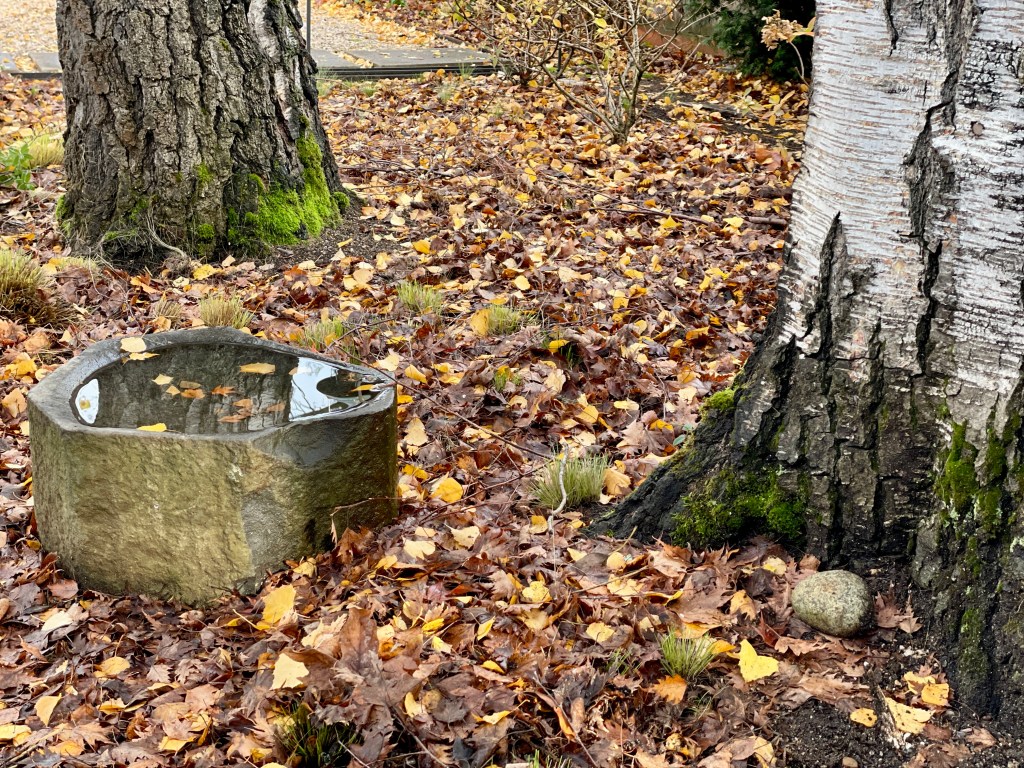
Now in autumn our yard is blanketed bright yellow. I resist raking until the birches are nearly barren, then tidy a bit in time for Thanksgiving, transferring leaves from the patch of grass to under the trees and into the borders to feed the soil and shelter the wintering insects.
This time after cleaning up I came inside, removed my mud-caked shoes, gazed out the window at my handiwork, and within a breath of satisfaction, the area under the birches came alive with a flurry of activity. My disruption of the leaves had apparently uncovered a bird buffet, lifted the silver dome to the smorgasbord. Ten dark-eyed juncos pecked away at the ground as though this might be their last meal. Ah yes, a real-life enactment of why we “leave the leaves” in autumn, because underneath is a megalopolis of bugs sleeping through winter.
I watched in delight and was heartened by the crowd. Birds finding food or refuge or habitat in my own back yard infuses me with a small sense of accomplishment, like I’m doing something right, at least by them, in this moment.
The feeling was short lived as I searched for other species in the mix, perhaps waiting their turn in the branches above. This has been a year of mostly juncos, few other species. In past years there were abundant house finches, goldfinches, pine siskins, golden-crowned sparrows, robins, flickers, even a red-breasted sapsucker and cooper’s hawk. But lately only the juncos, occasional red-breasted nuthatch, and my dependable two chickadees who I like to believe came from the brood of eight who fledged from my chickadee box last spring.
I wonder forlornly where the other species might have gone, and why. The crows decimated many nests this spring, as I learned from my neighbor and witnessed myself when walking my dog past crows picking apart baby birds. Would the house finches repopulate if the crows moved elsewhere next nesting season? How did the juncos survive them? As a bird collision volunteer, I can’t help assuming the other species died on windows or were eaten by cats, or perhaps their trees were cut down for a new home.
I sigh and profess my gratitude for the juncos. They are who I have today and I must allow them to make me happy because they could be gone tomorrow. They’re still wildlife, and their presence comforts me with the knowing that not all has disappeared yet. I was in effect forcing myself to be satisfied with what was out there because it was all I had. This sentiment reminded me of a concept I hear mentioned in many of the conservation articles, books, and podcasts I’ve been learning from – shifting baseline syndrome.
Shifting baseline syndrome is our gradual acceptance of environmental degradation as normal because it’s what we’re used to, or what we’ve grown up with. We compare what we see in nature today to what we grew up seeing, not to what was really there hundreds of years earlier. We accept as the baseline what we were born into, and so a slow continued degradation doesn’t seem all that bad. And then when the next generation comes along, they experience even less nature than we did, but since that is their baseline, it’s normal to them. And so on.
Even the baseline from a hundred years ago is insufficient because that baseline was determined well after our anthropogenic impacts had altered the land and diminished so many species. Because of “extinction of experience,” our great great grandchildren may see crows, racoons, and rats as adequate representations of wildlife, since that’s all that’s been available to them. Shifting baseline syndrome might be one reason that we as a society allow for so much continued destruction of nature in the forms of development, pollution, deregulation of wetlands, climate change, overfishing, etc. We only see it happening incrementally, but the collective impact over a hundred years is devastating.
The State of the Birds report shows that many bird populations have dropped precipitously in only fifty years, and continue to drop, mainly due to habitat loss. What we see today is much less than the abundance of birds that flew our skies a few hundred years ago, or even a few decades ago. But the lower numbers are normal to us now because our baseline has shifted. The same can be said for many species disappearing, including due to overfishing.
My dream is for a future where shifting baseline syndrome goes in reverse. That our great grandchildren have the opportunity to experience more wild lands and wild life than we have even today.
More healthy wetlands, more old-growth forests, more grasslands and meadows, more undeveloped coastline, more clean rivers and streams, and thriving within them, more wildlife. We would have all this because between now and a hundred years from now we worked together to preserve, restore, rewild, renature, and reintroduce all the nature that was meant to be here. We tried extra hard to mitigate the compounding effects of climate change because everyone decided it was the right thing to do for both us and the rest of life on earth.
We can’t save everything, like the coral reefs, but we can give mother nature a helping hand. A billion helping hands.
In the meantime I’ll keep protecting the birds, planting for pollinators, tending to the trees, speaking up, supporting the helpers, and holding tight to a baseline we can dream could be.

 Annegsherwood.com