We’re all doing the best we can with the information we have. Trying to be good citizens, neighbors, workers, parents, humans. So when we see what’s happening around the world and don’t know what to do about it, it can make us feel helpless. We’re already trying to be good at everything else!
There’s no shortage of important issues to choose from, but it’s simply not possible to tackle multiple issues no matter how important or urgent they are. It may not even be realistic to tackle one issue at the moment. Maybe we’re working full time alongside caring for kids or aging parents. Or maybe we’re going through a particularly stressful time and all we can do at the end of the day is turn off the lights.
Occasionally, though, we may be lucky enough to have a free hour to engage in a small action on a matter that weighs heavy on us. And then doing something ends up making us feel lighter and more at peace than if we’d done nothing.
Because I’ve been learning about biodiversity loss and the global consequences of ecosystems collapse, these are the issues I work on. (This Earth.org article is a very brief summary of biodiversity loss, but I’ve found the Wikipedia page to be quite comprehensive. And of course Google brings up many more references.) Alongside climate change, biodiversity loss and ecosystems collapse will affect the most life on our planet long-term. As Bill Gates said in his memo, most humans will be able to use technological advances to survive, but this leaves out all other species – the rest of life on earth, which is a pretty big omission.
I try to mitigate my impact on the planet with things like consuming less of everything, avoiding plastic, using solar to power my EV, planting pollinator-friendly plants, etc, but it never seems enough, so I feel the itch to do more.
One of the more impactful ways we can take action (other than voting for leaders who understand the importance of preserving our natural world), is to engage with our city/state/federal representatives to remind them that their constituents do care about saving the planet, be it via the local forest, urban trees, nearby wetlands.
Another is to use guidance from an organization that specializes in what we care about. For instance I receive weekly emails from the Center for Biological Diversity with a link to an action that takes a few seconds. Examples are here in their Current Action Alerts.
I’ve also started practicing engagement in public comment periods when they come up. For a long time I thought I wasn’t allowed to submit a comment unless I was an “expert” on the topic. Who was I to say what should be done to save endangered salmon when I didn’t know all the details about their lifecycles, the contents of their diets, precisely where they migrated, or the ecology of their habitats?
But if we take the stance of remaining silent unless we have degrees in wildlife biology or ecology, that leaves a whole lot of caring people feeling helpless. That leaves me feeling helpless.
In my last post about the Salish Sea I mentioned the endangered Marbled Murrelet. Earlier this year the Washington Department of Fish and Wildlife (WDFW) sent an email (I’m a subscriber) inviting public comment in regards to continuing their endangered species status because their numbers continue to fall. I missed the comment deadline because I was overwhelmed by the volume of emails in my inbox, and I wanted my comment to be well-researched so it held some validity. I’ve submitted comments in the past to my City Council about urban trees and conservation, and took so much time with those emails that it may have hindered me. And so I missed the opportunity to tell WDFW how important I believe it is to save endangered birds in our state. It’s not only about the birds.
Missing this opportunity, I wondered how I could streamline my process so that the time between receiving a public comment invitation and emailing my comment was a matter of minutes instead of days. I thought maybe if I had a template of sorts that encompassed the bigger picture of biodiversity loss, I could then add the specifics related to the topic at hand. Currently in my inbox are two invitations: one for “proposed land acquisitions” by WDFW, and one for “proposal to classify Island Marble Butterfly as endangered.”
Let’s use the Island Marble Butterfly as our experimental specimen. At the end of this post I pasted the entirety of the public comment invitation email to show what one typically looks like, but basically the email says that this species of butterfly is at high risk of extinction in Washington State, and WDFW is seeking public comment on the proposal to classify the butterfly as an endangered species, which would give it protected status and help the population survive.
Like most of the endangered species I read about, the alarm is not only about that individual species. When a species goes extinct, they could be telling us that something’s not right in their habitat. Perhaps it was pollution or overexploitation or pesticides or the destruction of their habitat entirely by development, logging, mining, or agriculture. Whatever it was that eradicated them, the animals didn’t decide to disappear on their own. Life wants to keep living.
So when an opportunity comes up to categorize a species as endangered, there is also the opportunity to promote healthier ecosystems for both humans and other species sharing those habitats. It’s also an opportunity for outreach to the public; the species acts as a tangible and visual example of what is at stake.
I’m sure I’ll be editing the following public comment template forever, and it’s somewhat simple for now, but I have to start somewhere.
_______________________
Dear WDFW,
Thank you for the opportunity to comment on WDFW’s pending consideration to classify the Island Marble Butterfly as endangered.
I live in Seattle and receive WDFW’s email updates weekly. These updates help me learn about how wildlife is managed in our state, and I appreciate the work WDFW does to protect our state’s biodiversity and all our wildlife.
Our planet has been experiencing rapid biodiversity loss for decades.
The loss of so many species, so much incredible life, is heartbreaking. They just want to continue living on our planet, but we’re not letting them. Legacies of overexploitation, overextraction, pollution, pesticides, development, and any number of other human interferences has made their survival very difficult.
But if humans have the power to cause these biodiversity losses, we also have the power to stop them. Nature didn’t need us before modern times, but it needs us now.
I support listing the Island Marble Butterfly as endangered for a few reasons.
- They deserve to live and thrive in their own right.
- Protecting them and their habitats may have the function of protecting other species within those areas. For instance by keeping their habitats undeveloped for other species as well.
- Protecting them and their habitats may have the function of improving those ecosystems for humans as well. For instance if pesticides are minimized, and access to nature is enhanced.
- Listing them as endangered provides a visual and tangible example of the nature we’re all trying to save. As was attempted with WDFW’s outreach in 2009, there’s another opportunity to inform the public about conservation, about essential host plants, the role of invasive species, and the impact of habitat loss on biodiversity. The story of their life stages as told in the Periodic Status Review is a lovely reminder of the miracles on our planet.
- Listing them as endangered shines a light on Washington State’s compassionate efforts to save nature.
- When we take steps to save nature, we’re also saving ourselves. What’s good for nature is good for our mental and physical health.
We can’t control what the rest of the world does, but we can have an impact closer to where we live. Please list the Island Marble Butterly as endangered. This butterfly effect may just lead to greater things.
I have missed opportunities to comment on other species, like the Marbled Murrelet, so please consider this comment as supporting other endangered species as well.
Thank you again for the opportunity to comment, and for all that WDFW does to preserve the beauty we have in our wonderful state.
______________________
I wrote this post to organize my own thoughts, but also to provide ideas for others who want to submit public comments or email their representatives about issues they care about. It can be daunting to do so, and we’re all busy and overwhelmed. We need all the collaboration we can get, and so I welcome feedback on how I can be more effective as well!
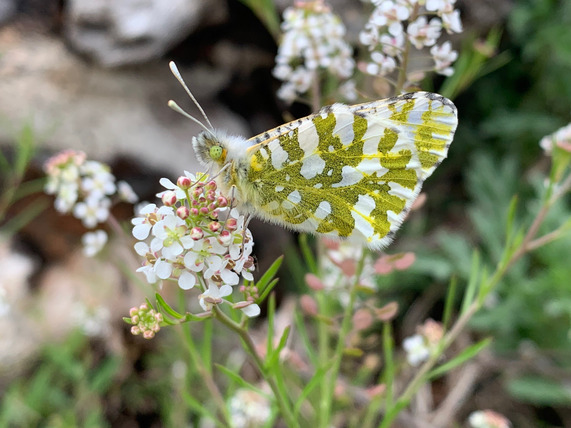
Below the photo is the email from WDFW inviting public comment about the Island Marble Butterfly, but I also found the notice on the WDFW homepage and Species & Habitats page.
OLYMPIA — The Washington Department of Fish and Wildlife (WDFW) is accepting public comment on a rule making proposal and State Environmental Policy Act (SEPA) determination for classifying the island marble butterfly as an endangered species in Washington. The public comment periods are open now through Dec. 5.
“There is only one remaining population of island marble in Washington, on San Juan Island,” said Taylor Cotton, WDFW conservation assessment section manager. “Captive rearing and augmentation efforts are likely the only thing keeping this population viable; this butterfly species is at high risk of extinction in our state.”
WDFW’s rule proposal to classify the island marble butterfly as endangered is now available on WDFW’s website. The public can submit comments on the proposal online, by email, by calling 855-925-2801 and entering code 10592, or by mailing WDFW ATTN: Scott Bird, P.O. Box 43200, Olympia, WA, 98504. A public hearing on the rule proposal is also scheduled for the December Washington Fish and Wildlife Commission meeting.
The public can view the SEPA determination on WDFW’s SEPA webpage. Comments on the SEPA determination may be submitted online or by email.
Following the public comment periods, WDFW staff will brief the Washington Fish and Wildlife Commission on the Department’s recent status report about the island marble butterfly and WDFW’s recommendation to list the species as endangered. The Commission is currently scheduled to decide on the proposal in December.
The island marble butterfly (Euchloe ausonides insulanus) is a medium-sized butterfly most easily recognized by expanded marbling on its wings. It was thought to be extirpated in Washington until its rediscovery in 1998 on San Juan Island. Today, the island marble’s range is restricted to a single complex of prairie, coastal dune, coastal bluffs, and lagoon habitats on San Juan Island.
The butterfly has been classified as an endangered species under the federal Endangered Species Act since 2020.The Washington Department of Fish and Wildlife works to preserve, protect, and perpetuate fish, wildlife, and ecosystems while providing sustainable fish and wildlife recreational and commercial opportunities.

 Annegsherwood.com