My bird collision monitoring route is a ten minute shuffle around one side of a building, the speed at which you’d search for lost keys in grass. Above us are floor-to-ceiling windows encircling the second floor, a feature that immerses the person looking out in the beauty and serenity invoked by the giant sequoias, cedars, and cypresses of the surrounding park.
We always hope to have an uneventful search, where the only birds we find are those flitting about in the ancient European Beech whose leafy reflection flutters in the windows. Finding a bird on the ground means a life has been lost.
At first sight, the spot in the grass appeared as a drop of nail polish in a color similar to the one I was wheedled to choose for a pedicure in Miami, on the spectrum of bright red outside my usual safe color choices.
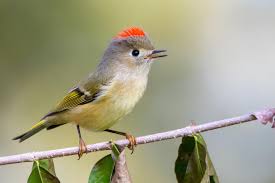
Inching closer to the tiny neon spot, my heart seized. His one crown jewel. A ruby fringed upright on his little head.
Ruby-crowned Kinglets (Corthylio calendula) are small songbirds who live in a variety of habitats across North America. Only the males have this fleck of color, which stays hidden unless they are excited. Had he been courting a partner that morning? And that’s why his crown was on brilliant display?
Or was it the shock of hitting the window that triggered his one last gasp of who he was.
We logged the coordinates of his location, some feet below the windows, then I bagged and documented him per protocol. The data would be used to analyze the rate of collisions at this location (one of many), with the purpose of encouraging building owners to install collision deterrents to save future bird populations, and to promote bird-safe window policies for new construction.
One might consider it a bit morbid to be so devoted to this line of volunteering. Couldn’t I just do the more uplifting bird counts that also collect important data tracking bird populations? Yes, and I sometimes do that too.
But bird collisions account for a billion bird deaths per year in North America alone. This, along with another two billion eaten by cats, and countless more disappearing due to habitat destruction, has contributed to a loss of a third of our bird populations in fifty years. In only my lifetime. Even that number seems low since by the time I was born in 1973, we had already lost so many in the years of DDT and feathered hats.
The reason I do this is for him and his 999,999,999 cousins who also needlessly lost their lives. It’s too heartbreaking for me to watch them disappear, and doing something about it, though rough at times, makes me feel like their lives are not lost in vain. That their sacrifice will lead to them saving other lives.
Birds hit windows because what they see on a window is the reflection of the sky or the trees, so they fly at bird-speed toward it. Their eyesight is just different from ours, and windows are a relatively new invention in the grand scheme of bird evolution. Birds who hit windows do not generally survive. Those who appear to fly away are usually so damaged with eye or brain injuries that they can’t function enough to find food or safety or their partners. It almost seems like a mercy when they die right away because at least their suffering is over.
Collision deterrents are incredibly successful in preventing mortalities. Here’s one of the larger project success stories from Chicago.
The building I monitor did end up installing deterrents. They weren’t aware of the collisions before, and were happy to help save lives. Their bird-safe windows now quietly show how much they care about the life on the other side.
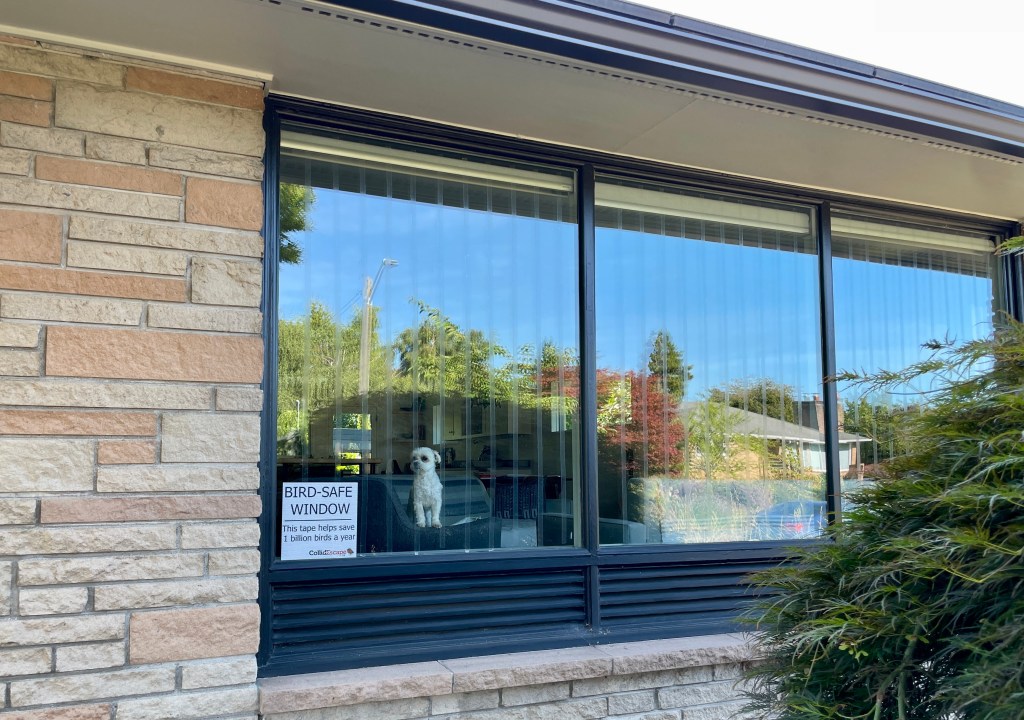
At my own home I’ve covered my front windows with CollidEscape tape because it’s easy to apply to large windows. My back windows are covered in Feather Friendly dots because they disappear into the view. I love the way my windows make me feel.
When we found the Kinglet last year, I was in my third season as a volunteer, part of a bigger multi-year project with Birds Connect Seattle. If you live in the Seattle area, there are other volunteer opportunities, as well as a calendar of bird outings I participated in as entry into birding.
Until the day of the Ruby-crowned Kinglet, I had not become emotional when finding a dead bird on the monitoring route. I told myself I was doing science, which requires a more or less detached observational state of mind so that one’s data does not skew based on the direction of one’s heart. But this one got me. He sat in the passenger seat as my fragile cargo even though he felt nothing.
On another day, grasped in the feet of a Yellow-rumped Warbler tucked in a concrete nook, were tufts of dried grass as though he had dragged himself across the ground to get to a safe place where he could recover. I could not help thinking of his last moments, and I promised him that his life would not be wasted. That’s why I wrote this post.


 Annegsherwood.com